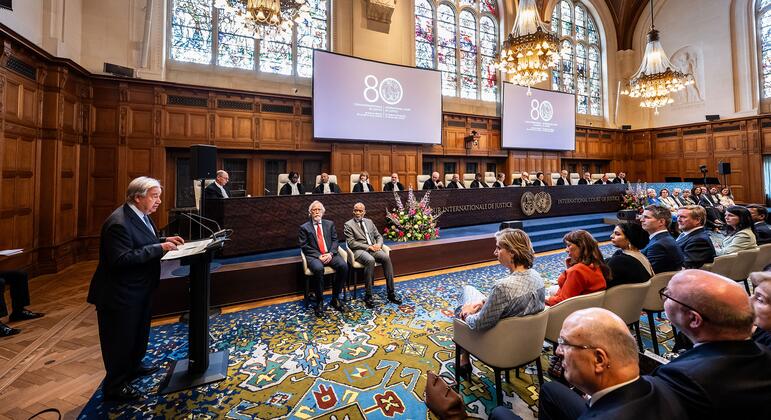

As the ‘World Court’ Turns 80: Guterres Says Law Must Prevail Over Force
Introduction
As the International Court of Justice (ICJ) reaches its 80th anniversary, United Nations Secretary-General António Guterres emphasizes a vital message: the law must supersede force in global governance. This celebration serves as a pivotal reminder of the court’s role in maintaining peace, resolving disputes, and upholding international law. In this article, we will explore the significance of the ICJ, its achievements, challenges, and the enduring necessity for legal structures in a world often governed by might.
The Role of the International Court of Justice
Founded in 1945, the International Court of Justice stands as the principal judicial organ of the United Nations. Its primary purpose is to settle legal disputes between states and provide advisory opinions on international legal issues referred to it. By promoting the rule of law, the ICJ plays a crucial role in ensuring that nations adhere to international treaties, human rights conventions, and customary laws.
Promoting Peaceful Resolution of Disputes
One of the ICJ’s key functions is the peaceful resolution of disputes. Over the decades, it has taken on a variety of cases ranging from territorial disputes to issues involving human rights. The court’s ability to provide binding resolutions is fundamental in preventing conflicts from escalating into violence, thereby fostering an environment of international cooperation.
Upholding Human Rights
The ICJ also plays a critical role in the promotion and protection of human rights. By interpreting and applying international human rights treaties, it holds states accountable for their obligations. This ensures that legal frameworks are not merely guidelines but obligations that must be honored, thereby contributing significantly to the security and dignity of individuals worldwide.
Guterres’ Call to Action
As the ICJ celebrates its 80th anniversary, Guterres’ remarks underscore a crucial point: the current geopolitical climate often leans toward unilateral actions that challenge legal norms. His assertion that “the law must prevail over force” speaks volumes about the need for a collective commitment to uphold international legal frameworks, especially in an era marked by rising tensions and conflicts.
Challenges of Global Governance
The world is witnessing an increasing trend of populism, nationalism, and unilateral actions that threaten the principle of multilateralism. Guterres points out that the very essence of peace and security is jeopardized when nations resort to might over legal frameworks. The challenge is not merely legal but moral, demanding a renaissance of the belief in law as a pathway to peace.
Achievements of the ICJ
Over its 80-year history, the ICJ has made substantial contributions to international law. Notable cases such as the “Nicaragua vs. United States” case in 1986 demonstrated the court’s ability to hold powerful states accountable. The verdict, which ruled against the U.S. for its military and paramilitary activities against Nicaragua, reinforced the importance of international law over unilateral actions.
Landmark Cases and Legal Precedents
The ICJ has set numerous legal precedents that shape international relations today. Its rulings on maritime boundaries, state sovereignty, and the prohibition of the use of force have been instrumental in creating a framework that governs state interactions. Each decision adds layers to international jurisprudence, fostering a more stable and predictable world order.
The Need for Continued Support
Despite its achievements, the ICJ faces obstacles. The court relies on the cooperation of states for the enforcement of its rulings. In instances where states defy its decisions, the effectiveness of the ICJ can be severely compromised. This dependency underscores the necessity for stronger mechanisms to ensure compliance.
Building Trust in International Law
To ensure that the law prevails over force, global leaders must foster faith in international institutions like the ICJ. This can be achieved through education, public awareness campaigns, and stronger diplomatic ties. By building a culture that respects and upholds the rule of law, nations can work collaboratively in resolving disputes.
The Future of the International Court of Justice
Looking ahead, the ICJ must adapt to the evolving challenges of the 21st century. Issues such as climate change, cyber warfare, and global pandemics require innovative legal frameworks. The court’s ability to address these new dimensions of international law will be pivotal in maintaining its relevance.
Expanding the Mandate of the ICJ
There’s potential for the ICJ to expand its mandate to include advisory opinions on pressing global issues. For example, climate change disputes could benefit from judicial insight, guiding nations toward legally binding commitments in collective environmental action. By staying at the forefront of global issues, the ICJ can reinforce the principle that law guides state behavior.
Conclusion
As the International Court of Justice commemorates its 80th anniversary, Guterres’ call for the law to prevail over force resonates more than ever. Amidst an increasingly complex global landscape, the rule of law, embodied by institutions like the ICJ, serves as a beacon for peace and justice. The world must recommit to the principles of international law, ensuring that legal frameworks guide state actions and promote a harmonious coexistence.
SEO Optimization Tips
To ensure this article reaches its audience effectively, here are some SEO optimization strategies utilized:
-
Keywords: The article integrates relevant keywords such as “International Court of Justice,” “rule of law,” “Guterres,” and “international law.”
-
Headings and Subheadings: Proper use of H1, H2, and H3 tags helps search engines understand the content hierarchy.
-
Internal Links: Including links to related articles or sections will improve the site’s navigation and boost SEO.
-
Meta Description: A concise meta description summarizing the article can enhance click-through rates.
-
Mobile Optimization: Ensuring the content is easily readable on mobile devices will improve user experience metrics, positively impacting search rankings.
By focusing on these elements, the discussion surrounding the ICJ can engage a wider audience, fostering awareness and encouraging dialogue on the importance of international law in today’s world.
For more details and the full reference, visit the source link below:
Read the complete article here: https://news.un.org/feed/view/en/story/2026/04/1167322