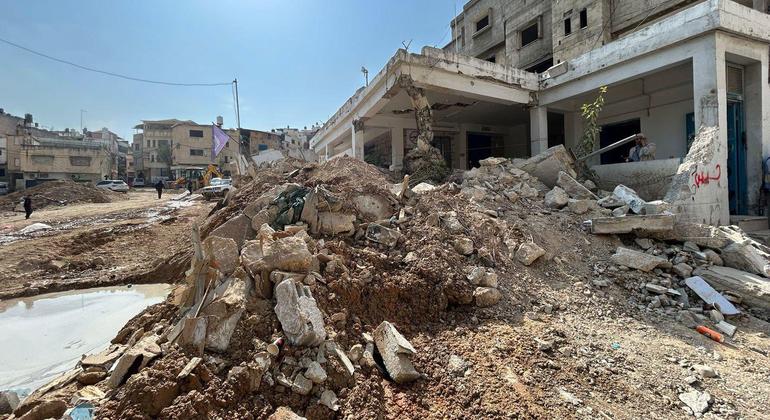

Security Council LIVE: Spotlight on Israeli Settlements in Occupied Palestinian Territory
Introduction
The Israeli-Palestinian conflict remains one of the most contentious issues in international relations. Central to this dispute is the issue of Israeli settlements in occupied Palestinian territories, which has drawn widespread condemnation and concern from the global community. In this article, we explore the ongoing debate surrounding these settlements, the role of the United Nations Security Council, and the implications for peace in the region.
Understanding Israeli Settlements
Israeli settlements refer to the communities established by Israel in territories it occupied during the 1967 Six-Day War, notably the West Bank, East Jerusalem, and the Golan Heights. These settlements range from small outposts to larger towns and cities, with thousands of Israeli citizens residing in them. The expansion of these settlements has significant political, social, and economic consequences for both Israelis and Palestinians.
Historical Background
The establishment of Israeli settlements in occupied territories traces back to the aftermath of the 1967 war. Under International Law, particularly the Fourth Geneva Convention, it is argued that an occupying power cannot transfer its civilian population into the territory it occupies. However, Israel disputes this interpretation, citing historical, religious, and security reasons for its settlement policies.
The Role of the United Nations Security Council
The United Nations Security Council (UNSC) plays a critical role in addressing issues related to Israeli settlements in occupied territories. The Council has passed several resolutions addressing the legality and consequences of these settlements, notably Resolution 242 and Resolution 338, which call for the withdrawal of Israeli armed forces and the acknowledgment of every state’s right to live in peace.
Recent UNSC Debates
In recent years, the UNSC has convened multiple sessions to discuss the ongoing expansion of Israeli settlements. These discussions highlight the tensions between member states, as countries vary in their approach to the issue. While many nations call for an end to settlement expansion, others, notably the United States, have historically supported Israel’s right to self-determination and security concerns.
International Law and Israeli Settlements
International law remains a key element in discussions regarding Israeli settlements. The Fourth Geneva Convention, specifically Article 49, forbids the transfer of an occupying power’s civilian population into the territory it occupies. This legal perspective forms the backbone of opposition against Israeli settlement expansion.
The Criticism from the Global Community
Numerous international bodies, including the UN General Assembly and the International Court of Justice (ICJ), have condemned Israeli settlements as illegal under international law. This has led to calls for sanctions against Israel and a demand for increased accountability in line with international human rights standards. The ongoing criticism from the global community underscores the complexities and polarizing aspects of the Israeli-Palestinian conflict.
Humanitarian Implications of Settlements
The expansion of Israeli settlements poses severe humanitarian challenges for the Palestinian population. As settlements grow, they often encroach on Palestinian land, leading to restrictions on movement, access to resources, and housing rights. This disruption of daily life has far-reaching implications for Palestinian communities, fostering resentment and further complicating peace efforts.
Economic Impact
The economic ramifications of Israeli settlements are significant. They disrupt Palestinian agriculture, restrict access to crucial resources such as water, and hinder economic development. Additionally, the associated military presence and security measures contribute to a challenging environment for local businesses.
Peace Process and Settlement Expansion
The ongoing expansion of Israeli settlements has become a central issue in peace negotiations between Israelis and Palestinians. Each round of talks is deeply impacted by settlement activities, often leading to stalled negotiations and exacerbating tensions.
The Two-State Solution
Many experts argue that the viability of the two-state solution is endangered by the continued expansion of Israeli settlements. The ideal of a separate and sovereign Palestinian state alongside Israel becomes increasingly difficult to realize as land becomes fragmented by settlements.
The Viewpoints of Key Stakeholders
Israeli Government Perspective
The Israeli government views the settlements as a legitimate expression of the Jewish right to the land, citing historical and religious claims. Politically, settlement expansion is often framed as a necessary measure to ensure Israel’s security.
Palestinian Authority Position
The Palestinian Authority (PA) vehemently opposes Israeli settlements, viewing them as a major obstacle to peace. The PA argues that settlement expansion undermines the prospects for an independent Palestinian state and exacerbates existing tensions.
Conclusion
The issue of Israeli settlements in occupied Palestinian territories is at the forefront of the Israeli-Palestinian conflict. As the UNSC continues to spotlight this matter, the pursuit of peace remains complicated by differing interpretations of international law, national narratives, and humanitarian concerns.
The Path Forward
Finding common ground to resolve this complex issue requires not only diplomatic efforts but also a commitment to addressing the underlying grievances of both parties. In the long run, the focus needs to shift toward building trust and fostering mutual respect, which are vital components of any lasting solution to the conflict.
Importance of International Engagement
Lastly, sustained international attention and pressure concerning the legality and consequences of Israeli settlements will be crucial in advancing peace talks. The role of the Security Council, along with other international actors, will remain essential in addressing this multifaceted challenge.
In summary, as discussions continue at the UN Security Council and beyond, the necessity for a fair resolution that addresses the rights and concerns of both Israelis and Palestinians has never been more urgent.
For more details and the full reference, visit the source link below:
Read the complete article here: https://news.un.org/feed/view/en/story/2026/06/1167830