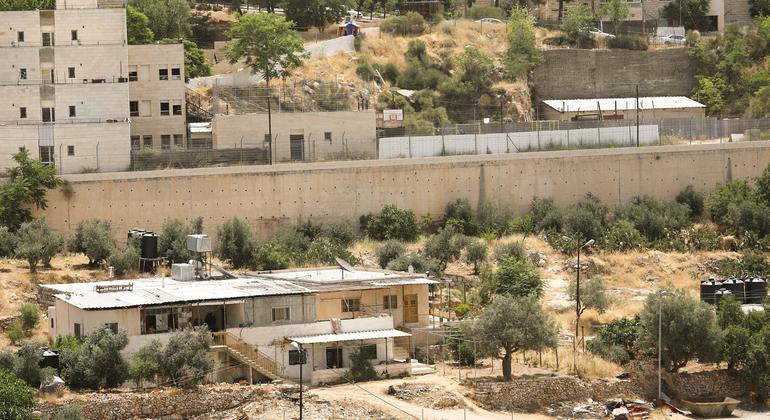

Guterres: Fast-Tracking West Bank Outposts is a ‘Flagrant Violation’ of International Law
Introduction
In recent months, the Israeli government’s moves to fast-track the development of outposts in the West Bank have drawn significant international attention and condemnation. United Nations Secretary-General António Guterres has categorized these actions as a “flagrant violation” of international law, highlighting the growing concern among global leaders regarding the Israeli-Palestinian conflict. Understanding the implications of this statement is crucial for both international relations and the pursuit of peace in the region.
Background on the Israeli-Palestinian Conflict
The Israeli-Palestinian conflict has deep historical roots, centered around issues of territory, national identity, and governance. Since the establishment of the State of Israel in 1948, the status of the West Bank, Gaza Strip, and East Jerusalem has been a contentious issue. The United Nations and various international bodies have continually sought resolutions, yet the situation remains unresolved, with escalating tensions affecting millions of lives.
What Are the Outposts?
Outposts are informal Jewish settlements established in the West Bank without official approval from the Israeli government. However, in practice, many of these outposts receive support from the government in various forms, whether through infrastructure development or security measures. Despite their informal status, they contribute to the Israeli settlement enterprise, which is widely viewed as illegal by the international community.
Guterres’ Statement: Significance and Implications
When Guterres referred to the fast-tracking of these outposts as a “flagrant violation” of international law, he underscored several key points:
1. Violations of the Fourth Geneva Convention
The establishment of Israeli settlements in occupied territory is considered a violation of the Fourth Geneva Convention, which prohibits the transfer of an occupying power’s civilian population into the territory it occupies.
2. Undermining Peace Efforts
Statements by the UN Secretary-General indicate that such actions will further complicate peace negotiations between Israelis and Palestinians. By expanding settlements, the Israeli government jeopardizes the feasibility of a two-state solution, which has been internationally endorsed as the pathway to peace.
3. Heightened Tensions
Guterres emphasized that these developments could exacerbate tensions not only among Israelis and Palestinians but also in the wider Middle East. The repercussions of unilateral actions could lead to increased violence, further endangering civilians on both sides.
International Reactions
The UN’s condemnation of Israeli outpost expansion resonates with a broader international disappointment regarding Israel’s policies in the West Bank. Nations and organizations have rallied in support of Guterres’ statement, reinforcing the legitimacy of international law in conflicts.
U.S. Response
While U.S. policies toward Israel have often been supportive, recent expressions of discontent signal a possible shift. U.S. officials have voiced concerns regarding the negative impact of settlement expansion on peace negotiations, echoing sentiments similar to those expressed by Guterres.
European Union
The European Union has consistently categorized the expansion of Israeli settlements as illegal under international law. Recent statements from EU officials reflect a desire for both parties to return to peaceful negotiations without unilateral actions that could alter the status quo.
The Role of the United Nations
The United Nations has been a persistent advocate for resolving the Israeli-Palestinian conflict. Through numerous resolutions and discussions, it has called attention to issues of human rights, sovereignty, and the principles of international law.
Peacekeeping Missions
In addition to diplomatic efforts, the UN has engaged in peacekeeping missions and observer teams in the region. These missions aim to monitor the situation on the ground and report any violations, helping to maintain a fragile status quo amidst ongoing tensions.
The Future of the West Bank
What lies ahead for the West Bank, considering Guterres’ assertions? While it is difficult to predict, the urgency of addressing these concerns has never been greater.
Political Solutions
For sustained peace, both Israeli and Palestinian leaders must engage in meaningful dialogue. The two-state solution remains the most recognized framework for a political resolution, yet continued expansion of settlements raises questions about its viability.
International Pressure
The international community must apply consistent pressure on both sides, especially Israel, to uphold international law. This includes economic sanctions, travel restrictions, and diplomatic measures that can act as deterrents against settlement expansion.
Conclusion
Guterres’ declaration regarding the fast-tracking of West Bank outposts encapsulates the complex and fraught nature of the Israeli-Palestinian conflict. It signals a call to action for both diplomats and global citizens to advocate for peace and justice, rooted in adherence to international law. The path forward is daunting, but only through collective efforts can we hope to achieve lasting peace and coexistence in the region. The world watches closely, hoping for a resolution that respects the rights and aspirations of both Israelis and Palestinians.
For more details and the full reference, visit the source link below:
Read the complete article here: https://news.un.org/feed/view/en/story/2026/07/1168035