

WASHINGTON, D.C. – November 23, 2026 (STL.News) President Donald Trump has given Iran a new ultimatum: reach a nuclear deal by the New Year, or the United States may resume military strikes in 2027. The Trump Iran ultimatum came in a Fox News interview over the weekend and was followed Monday by a sharp response from Tehran, which said the Strait of Hormuz could reopen quickly, but only on Iran’s terms.
The president also warned that any Iranian warships that try to break the U.S. naval blockade would be sunk. A Kuwaiti newspaper separately reported that Washington has given Tehran four days to answer a new negotiating proposal, though no U.S. official has confirmed that report.
The exchange leaves the nearly nine-month conflict in a familiar place: military pressure and threats on one track, mediated talks through Pakistan and Qatar on the other, and no agreement in sight.
What Trump’s Iran Ultimatum Says
In an interview with Fox News chief foreign correspondent Trey Yingst on Sunday, November 22, Trump said he is inclined to restart strikes against Iran after the New Year if negotiations fail to produce an agreement that blocks Tehran from obtaining a nuclear weapon, according to Fox News and Gulf News.
Trump accused Iranian negotiators of stalling. He called them “professional tap dancers” and said Iran has become more aggressive since the November 3 U.S. midterm elections.
Asked whether Iran might test the American blockade of its ports, the president said he hoped it would, warning that Iranian ships would end up at the bottom of the sea along with the rest of the country’s navy.
Trump also said he wants any agreement to be permanent, one that a future U.S. president could not easily undo. He has made the same point several times in recent days, telling reporters the United States wants a “real deal” rather than a temporary one.
The New Year timeline is consistent with what Trump told Israel’s Channel 12 last week: that he is in no hurry to decide on his next move and could wait until 2027.
Trump Says Iranian Attacks Have Spiked
On Sunday, Trump posted on Truth Social that Iran had launched more drones and missiles in the past week than at any time in more than a year, while adding that the attacks had done no damage. He linked the increase to the outcome of the midterm elections.
The weekend brought a series of incidents across the Gulf:
- Bahrain: Bahrain said an Iranian attack on Saturday, November 21, struck a civilian industrial facility, causing a fire. Saudi Arabia, Kuwait, Qatar and the United Arab Emirates condemned the attack.
- U.S. travel warning: The State Department urged Americans in Bahrain to practice heightened vigilance because of a rising threat of attacks by Iran and its allies on U.S. facilities.
- Gulf of Oman: The U.K. Maritime Trade Operations center reported an incident on Sunday involving a tanker and “military forces” near Chabahar. A maritime security analyst said U.S. forces struck a tanker carrying Iranian oil, but neither Washington nor Tehran has officially confirmed that account.
- Drone claim: Iran’s Revolutionary Guards said they shot down a U.S. drone near the Strait of Hormuz. U.S. Central Command had not commented on that claim.
Several of these reports come from one side of the conflict and have not been independently verified.
Reported Four-Day Deadline Remains Unconfirmed
Kuwait’s Al-Jarida newspaper reported that the United States has given Iran four days to respond to a new proposal covering the Strait of Hormuz, Iran’s nuclear program and sanctions, as summarized by Times Kuwait.
The report relies on a single unnamed source in Iran’s Foreign Ministry. No American official has confirmed it, and the White House has not publicly described any four-day deadline.
According to that report, Washington rejected Iranian Foreign Minister Abbas Araghchi’s offer to reopen the strait within two days as unrealistic and sent back its own framework. The reported U.S. terms would:
- Require Iran to restore shipping through the Strait of Hormuz to its pre-war state, in exchange for a gradual easing of the U.S. naval blockade and some oil sanctions.
- Require Iran to pause uranium enrichment, accept full International Atomic Energy Agency inspections and disclose where its highly enriched uranium is stored.
- Allow a gradual release of some frozen Iranian funds, limited to essential goods under U.S. financial oversight.
- Keep the Lebanon issue outside the bilateral talks.
Until Washington or Tehran confirms those terms, readers should treat them as reported rather than established.
Iran Responds: Lift the Blockade First
Tehran answered on Monday by restating its own conditions.
Foreign Ministry spokesman Esmaeil Baqaei said navigation through the Strait of Hormuz could be restored “in the shortest possible time” if the United States meets Iran’s demands, according to Gulf News and ABC News. Those demands include lifting sanctions, ending the U.S. naval blockade and carrying out all the terms of a memorandum of understanding the two sides reached in June.
Baqaei said U.S. threats would only strengthen Iran’s resolve. He added that Pakistan and Qatar are continuing their mediation.
Other senior officials struck a harder tone:
- Mohammad Bagher Ghalibaf, the speaker of Iran’s parliament and its chief negotiator, said Iran cannot remain indefinitely in a state of “neither war nor peace” and called for lasting deterrence against another attack.
- Kazem Gharibabadi, a deputy foreign minister, described the U.S. blockade as an act of war.
- Abbas Araghchi, the foreign minister, said reopening the strait would not be difficult if Washington accepts Iran’s conditions, and that nuclear talks would follow only after that first step.
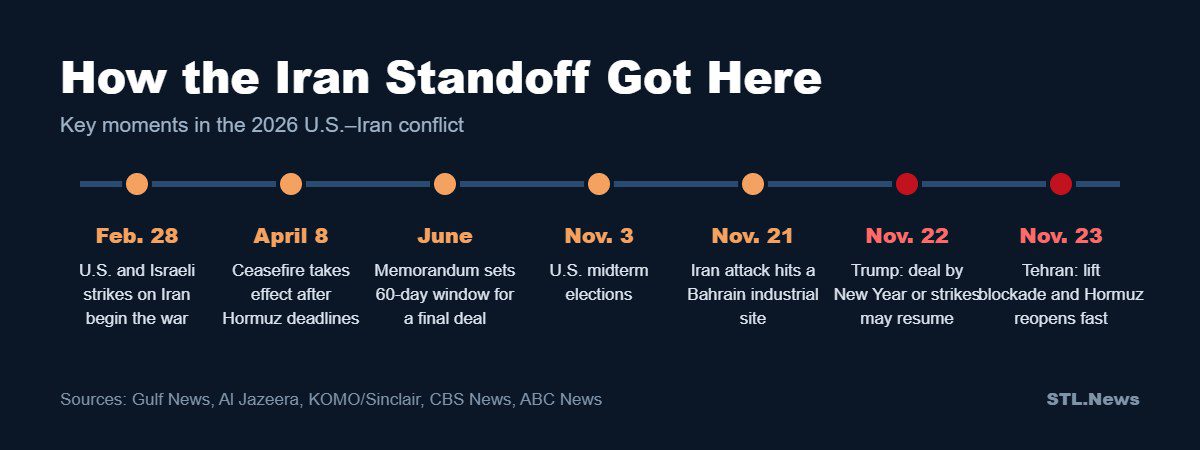
How the Iran Standoff Reached This Point
The current conflict began on February 28, 2026, when U.S. and Israeli forces launched strikes on Iran. Trump issued a series of deadlines in March and April tied to reopening the Strait of Hormuz, several of which he extended. A ceasefire took effect April 8.
A June memorandum of understanding set a 60-day window for a final agreement. That window passed without a deal, and fighting has flared repeatedly since, including the U.S. strikes near the Strait of Hormuz earlier this month.
Trump’s messaging has shifted several times in November. Shortly after the midterms, he said the United States did not need a deal with Iran because it holds billions of dollars in frozen Iranian funds. Last week, he said there was an “indication” Iran was looking to develop chemical or biological weapons, without offering evidence; Iran’s Foreign Ministry rejected the accusation.
In Congress, the Senate last week rejected a war powers resolution on Iran by a 48-51 vote, according to CBS News. The vote leaves the decision on renewed strikes with the White House.
Trump also discussed Iran with Russian President Vladimir Putin and Chinese President Xi Jinping at last week’s APEC summit in China, saying the leaders agreed Iran should never have a nuclear weapon. STL.News covered that meeting in Trump Reveals China Summit Results and AI Plans.
Why the Iran Ultimatum Matters for Oil, Gas and Markets
The Strait of Hormuz is one of the world’s most important routes for crude oil and liquefied natural gas. Any renewed fighting, or any deal that reopens normal shipping, could move energy prices quickly.
For drivers in St. Louis and across the country, the stakes show up at the pump. STL.News has examined whether high gas prices could push America into a recession and why gas stays expensive despite record U.S. oil production. Trump said over the weekend that oil prices have dropped sharply since the election.
Investors are also watching. Wall Street staged a strong rebound on Monday; see today’s stock market report for the full closing numbers.
What Happens Next
Three questions will shape the coming weeks:
- Does the four-day report hold up? If Washington confirms a short deadline, the pressure on Tehran becomes far more immediate than a New Year target.
- Does Iran test the blockade? Reports conflict over whether Iran will send a convoy of tankers through the area. Trump has said any Iranian warships that try to break the blockade would be destroyed.
- Can the mediators close the gap? Pakistan and Qatar are still carrying messages, but the two sides disagree on the order of steps: Washington wants nuclear commitments first, while Iran wants the blockade and sanctions lifted first.
For now, Trump’s Iran ultimatum sets the New Year as the next major marker. Whether that date brings a deal, renewed strikes or another extension, as earlier deadlines did, remains uncertain.
Frequently Asked Questions
What is Trump’s new ultimatum to Iran?
Trump said on November 22 that he is inclined to resume U.S. strikes on Iran after the New Year if the two countries do not reach a nuclear agreement by then.
Did the U.S. give Iran four days to respond?
Kuwait’s Al-Jarida reported a four-day window, citing an anonymous Iranian Foreign Ministry source. No U.S. official has confirmed it.
What does Iran want before reopening the Strait of Hormuz?
Iran says the United States must lift its naval blockade and sanctions and carry out the June memorandum of understanding. Its foreign ministry says shipping could then be restored quickly.
Who is mediating between the U.S. and Iran?
Pakistan and Qatar are the main mediators, according to Iran’s Foreign Ministry.
Sources and Editorial Disclaimer
This article is based on independently reported information available November 23, 2026.
Primary reporting and references:
- Fox News, November 22, 2026: interview with President Trump by Trey Yingst.
- Gulf News, November 23, 2026: live coverage of Trump’s remarks and Iranian responses.
- ABC News, November 22–23, 2026: Iran live updates.
- CBS News, November 18–23, 2026: Iran war live updates.
- Times Kuwait, November 23, 2026, citing Al-Jarida: reported four-day U.S. deadline.
Editorial disclaimer: Military claims, casualty reports and maritime incidents are attributed to the government, military or outlet that made them when independent verification was not available. The reported four-day deadline rests on a single anonymous source and has not been confirmed by U.S. officials. Graphics in this article were produced by STL.News.


